


2026-2028

15 countries - Africa, Latin America, Asia and MENA regions

Funder: Co-Develop
Digital Public Infrastructure (DPI) is transforming how people access identity, payments, and public services. Yet countries often lack the evidence needed to understand who benefits from these systems, who remains excluded and why.
The DPI Inclusivity Measurement Project supports governments in measuring how inclusive their digital public infrastructure really is. Through partnerships with research institutions, international organisations and public agencies in various country settings, GDN is developing and implementing the first cross-country toolkit to assess inclusion across digital identity and digital payment systems.
The programme combines rigorous household-level research with government engagement to generate comparable evidence on the barriers different population groups face in accessing and using DPI. By strengthening national capacity to measure inclusion, the project helps governments design digital systems that are more equitable, responsive, and accessible to all.
In this next phase, GDN will source, design, and guide inclusivity measurement projects in up to 15 countries, while working closely with governments and local partners to ensure that the resulting evidence translates into improved DPI implementation. The programme aims to expand the availability of high-quality data on digital inclusion, strengthen national ecosystems that can respond to exclusion challenges, and encourage broader support from multilateral development banks and philanthropic actors. Ultimately, the project seeks to help countries deploy DPI in ways that reach and benefit vulnerable and marginalised groups.
The programme combines global research standards with locally led implementation. Working closely with governments, national research institutions, and digital ecosystem stakeholders, GDN supports countries throughout the research and policy cycle—from study design to policy uptake.
The project:
By embedding research within national policy processes, the programme ensures that evidence informs decisions on how to deploy Digital Public Infrastructure in ways that are more inclusive, equitable and responsive to the needs of vulnerable communities.

South Asian Network on Economic Modeling (SANEM), Bangladesh examines inclusivity across Bangladesh’s digital identity, digital payments and digital public services to identify who is being left behind. Combining a nationally representative survey with qualitative research, the study explores barriers faced by women, older persons, people with disabilities, ethnic minorities and other marginalised groups.

Institute for Development, Sierra Leone, studies inclusion in Sierra Leone’s biometric National Identity Card system, the foundation of the country’s digital public infrastructure. Using household surveys and qualitative research, the team examines barriers to access and meaningful use, generating evidence to inform more inclusive DPI policies and governance.

University of Ghana examines inclusion in Ghana’s mobile money ecosystem, the country’s core digital payments infrastructure. The research investigates barriers to access, use and security for vulnerable groups, with the aim of informing more inclusive digital payments policies and system design.

Universidad Andrés Bello, MagentaC, and Analyze, have collaborated to study ClaveUnica, Chile’s national digital identity system. They examine access, enrollment, meaningful use, and rights among groups including older adults, rural communities, and migrants. The research also explores how poor interoperability shifts the burden onto citizens, effectively turning them into a human API, and aims to inform the institutions designing and operating Chile’s DPI.

University of Indonesia LPEM will examine how digital identity and payment systems contribute to inclusive DPI in Indonesia. The research will assess whether systems such as IKD, QRIS and BI-FAST enable meaningful access to public services, social protection and economic opportunities, while identifying barriers related to affordability, digital literacy, accessibility, connectivity, trust and privacy, particularly for women and other potentially excluded groups.

Held in New Delhi in June 2026, the workshop featured a presentation by GDN President Jean-Louis Arcand titled "AI, Inequality and Development: Rethinking Inclusion in the Digital Age."

GDN participated in the WSIS Forum 2026 in Geneva, where Balu spoke on a panel hosted by Co-Develop alongside GIZ, ITU and GSMA. Drawing on GDN's DPI Inclusivity Measurement Programme, he highlighted the need for gender-disaggregated data to identify who is being left behind and called for inclusion measurement to become a core investment.

GDN participated in the Forum for Tax Reform in July 2026, organised by ICTD and the Zambia Revenue Authority, where Saurabh joined the Systems working group on DPI, AI and taxation. He highlighted the importance of locally led, inclusion-focused research that engages policymakers from the outset. The group also concluded that successful AI deployment depends on clearly defined policy objectives to ensure effective implementation, appropriate safeguards and meaningful impact assessment.
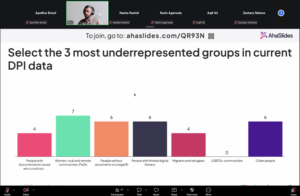
GDN co-hosted a Community of Practice with the DPI Map community at the UCL Institute for Innovation and Public Purpose, bringing together policymakers, researchers and practitioners to discuss how to measure inclusion in digital public infrastructure (DPI). Participants agreed that registration alone does not guarantee inclusion and highlighted the need for standardised methodologies, better data and stronger political commitment. The discussion also informed GDN's DPI Inclusivity Measurement Programme, which is developing practical tools to help countries measure and improve DPI inclusion.

Uganda’s maiden Baseline Education Census maps more than 100,000 schools and institutions, recording ownership structures, teacher payrolls, and GPS coordinates for every registered school in the country. Connecting this data to Uganda’s tax system could substantially broaden the revenue base, with the numbers to make that case now traceable and defensible for the first time.
If you have questions, please contact the Inclusivity team at DPI@gdn.int.
You can also subscribe to the GDN newsletter to receive the latest programme updates and announcements.