

Inclusive Digital Transformation Research Facility

A Global South–led platform run by the Global Development Network (GDN) to advance research for a digital future that works for everyone.

What the Facility Does

Digitalisation is accelerating across the Global South: from digital ID systems, data exchanges, and open public platforms to new forms of automation and emerging AI tools. The facility supports this transformation by strengthening the research ecosystems needed to understand, shape, and improve it.


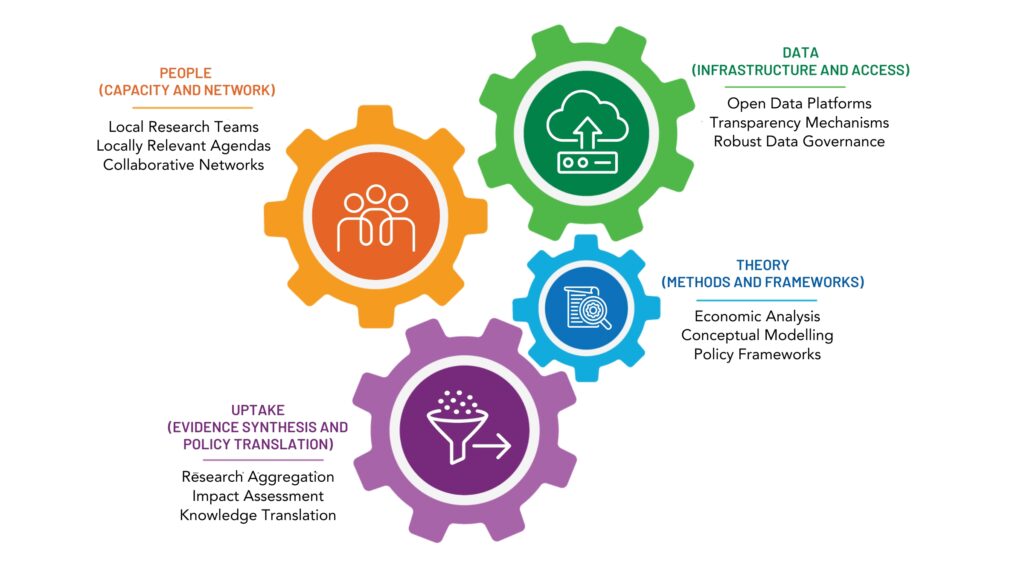
Our work is built around four interconnected areas: People, Data, Uptake and Theory. 
These four areas reinforce each other creating an environment where research, experience, and policy can move together.

People: Building a Strong and Diverse Research Community
We connect and support researchers across disciplines and across low- and middle-income countries (LMICs) who are studying digital transformation in real-world settings. To answer the questions we have about how digitalisation is reshaping economies and societies, we need a research community that reflects the diversity of contexts, institutions, and lived experiences in LMICs. This includes strengthening local teams, offering mentorship and training, and enabling collaboration through conferences, workshops, and communities of practice. Examples include the research teams in Bangladesh, Benin, and Ethiopia who completed pilot studies on the impact of DPI, and the network convened during the Economics of Digital Public Infrastructure conference.
Data: Supporting Multi-Stakeholder Collaboration Around Digitalisation Data
We support multi-stakeholder collaborations that connect local researchers with the institutions responsible for digital systems and data in their countries. Our aim is to ensure that existing data can be used to answer pressing research questions, and that research, in turn, contributes to expanding and strengthening the evidence base in support of implementation. We work with governments, implementers, and other data holders to identify, access, and responsibly use administrative, survey, and operational data, and to combine them with open-source data such as remote sensing. Underlying this is a recognition that digital public infrastructure (DPI) is an effort to embed data across all aspects of service delivery. The facility helps turn this embedded data into a resource for evaluation, learning, and course correction, while protecting privacy and supporting responsible governance. For instance, research projects have collaborated with government agencies and multilaterals to use administrative data, surveys, and operational datasets in addition to leveraging open source data such as remote sensing Night Time Lights (NTL) data.
Uptake: Bringing Evidence Into Practice
Bringing evidence into practice We work with partners such as the World Bank and other multilateral and regional organisations, alongside national policymakers and implementers, to ensure that researchers and policy actors interact throughout the life of a programme and can feed off each other’s questions, data, and insights. Rather than working in isolation, research is designed and discussed with the actors who shape digital policy and implementation. Engagements around Open Transaction Networks (OTN), panel discussions at global digital summits, and the co-construction of the pilot project in Benin between ACED and ASIN demonstrate how research can be informed by policymakers’ needs and, in turn, inform design choices in real time.
Theory and Methods: Creating Shared Analytical Foundations
At the centre of the facility is a Theory and Methods Lab that works across programmes, with the ambition to plug key gaps in our theoretical understanding of digitalisation’s impact on society and on economies. We are explicit about our focus on economic theory: we develop and refine economic frameworks that can explain how digital public infrastructure, digital markets, and AI-driven systems affect inclusion, productivity, governance, and welfare. In close collaboration with research teams across LMICs, we also design methods and tools to empirically probe these theories so that evidence from country-level implementation feeds back into theory and improves it over time. The Economics of DPI research agenda, the discussions held at the Global Development Conference, and GDN’s in-house expertise in developing the Economics of Open Transaction Networks are examples of this work.

More About Our Work

Why Does GDN Work on Digitalisation (and What Are We Up To) ?

Why would an international organisation with a mandate to strengthen the social sciences in low- and middle-income countries (LMICs) focus on digitalisation? Read the blog to learn more.
The Socioeconomic Impacts of DPI in Bangladesh, Benin & Ethiopia

In partnership with Co-Develop, GDN launched a pilot which implemented innovative research methods to evaluate the socioeconomic impacts of DPI in Bangladesh, Benin and Ethiopia. Learn more about the findings.
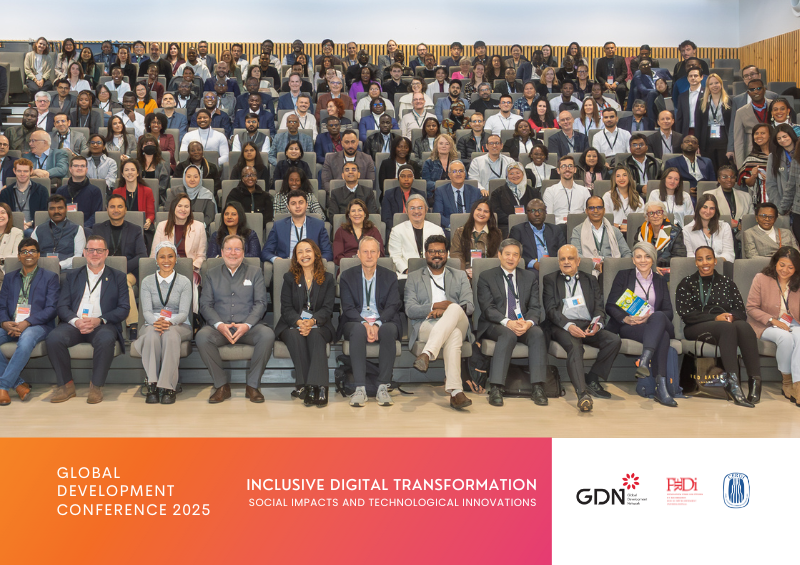
Global Development Conference 2025

GDC 2025 brought together over 600 academics, policymakers, practitioners and young innovators from more than 80 nationalities to discuss the theme Inclusive Digital Transformation: Social Impacts and Technological Innovations.

GlobalDev Series on Digitalisation

Check out a special series on digitalisation launched by GlobalDev (GDN's research communications platform) in collaboration with the Institute for Development Studies (IDS).


Our Partners

Stay Connected

To learn more or explore opportunities, write to dpi@gdn.int